


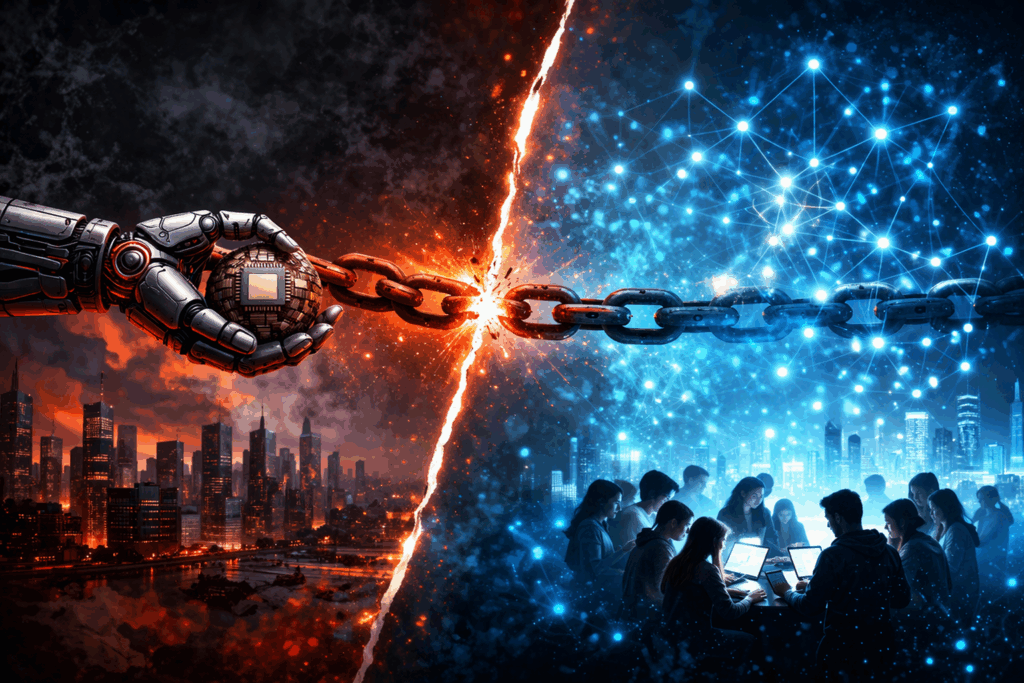
Artificial Intelligence is no longer a futuristic concept—it’s already shaping how we work, build, and innovate. But there’s a deeper shift happening beneath the surface, something more powerful than just new models or tools.
It’s the Open Revolution.
And if you look closely, open source isn’t just supporting AI—it’s defining its future.
AI Was Never Meant to Be Closed
In the early days, AI innovation was dominated by a few large organizations with massive compute power and proprietary models. Access was limited, experimentation was expensive, and innovation was centralized.
But that model doesn’t scale for the world we’re entering.
AI is not just for big tech anymore—it’s for developers, startups, researchers, governments, and even students. And that shift is only possible because of open source.
Open Source is Breaking the Barriers Open source has fundamentally changed how AI is built and distributed.
Today, anyone can:
Projects like Meta’s LLaMA, Hugging Face ecosystem, and frameworks like PyTorch have democratized access in ways we couldn’t imagine a few years ago.
The result? Innovation is no longer limited by access—it’s driven by creativity.
AI for All — Not Just a Vision AI for All” sounds like a slogan, but open source is turning it into reality.
Speed of Innovation is Exploding
Open ecosystems move faster. Period.
Instead of reinventing the wheel, developers build on top of existing tools. Improvements are shared, bugs are fixed collectively, and new ideas spread globally within days.
This creates a compounding effect:
The Rise of Edge AI + Open Models
One of the most exciting shifts is happening at the edge.
Open-source AI models are now being optimized to run on:
This is huge.
It means AI is moving closer to real-world applications—autonomous systems, robotics, smart surveillance, industrial automation.
And open source is making it possible to build all of this without being locked into a vendor ecosystem.
The Future: Open + Collaborative AI
The future of AI won’t be controlled by a single company or platform.
It will be:
Because the real power of AI doesn’t come from exclusivity—it comes from accessibility.
It’s the Open Revolution.
And if you look closely, open source isn’t just supporting AI—it’s defining its future.
AI Was Never Meant to Be Closed
In the early days, AI innovation was dominated by a few large organizations with massive compute power and proprietary models. Access was limited, experimentation was expensive, and innovation was centralized.
But that model doesn’t scale for the world we’re entering.
AI is not just for big tech anymore—it’s for developers, startups, researchers, governments, and even students. And that shift is only possible because of open source.
Open Source is Breaking the Barriers Open source has fundamentally changed how AI is built and distributed.
Today, anyone can:
- Access state-of-the-art models
- Fine-tune them for specific use cases
- Deploy them on edge devices or cloud
- Build products without starting from scratch
Projects like Meta’s LLaMA, Hugging Face ecosystem, and frameworks like PyTorch have democratized access in ways we couldn’t imagine a few years ago.
The result? Innovation is no longer limited by access—it’s driven by creativity.
AI for All — Not Just a Vision AI for All” sounds like a slogan, but open source is turning it into reality.
- A student in India can build a chatbot
- A startup can create a domain-specific AI product
- Enterprises can deploy secure, customizable models
- Governments can build sovereign AI systems
Speed of Innovation is Exploding
Open ecosystems move faster. Period.
Instead of reinventing the wheel, developers build on top of existing tools. Improvements are shared, bugs are fixed collectively, and new ideas spread globally within days.
This creates a compounding effect:
- Faster experimentation
- Lower development cost
- Rapid iteration cycles
The Rise of Edge AI + Open Models
One of the most exciting shifts is happening at the edge.
Open-source AI models are now being optimized to run on:
- Embedded systems
- IoT devices
- ARM-based architectures
- Local servers without cloud dependency
This is huge.
It means AI is moving closer to real-world applications—autonomous systems, robotics, smart surveillance, industrial automation.
And open source is making it possible to build all of this without being locked into a vendor ecosystem.
The Future: Open + Collaborative AI
The future of AI won’t be controlled by a single company or platform.
It will be:
- Open
- Collaborative
- Distributed
- Community-driven
Because the real power of AI doesn’t come from exclusivity—it comes from accessibility.