


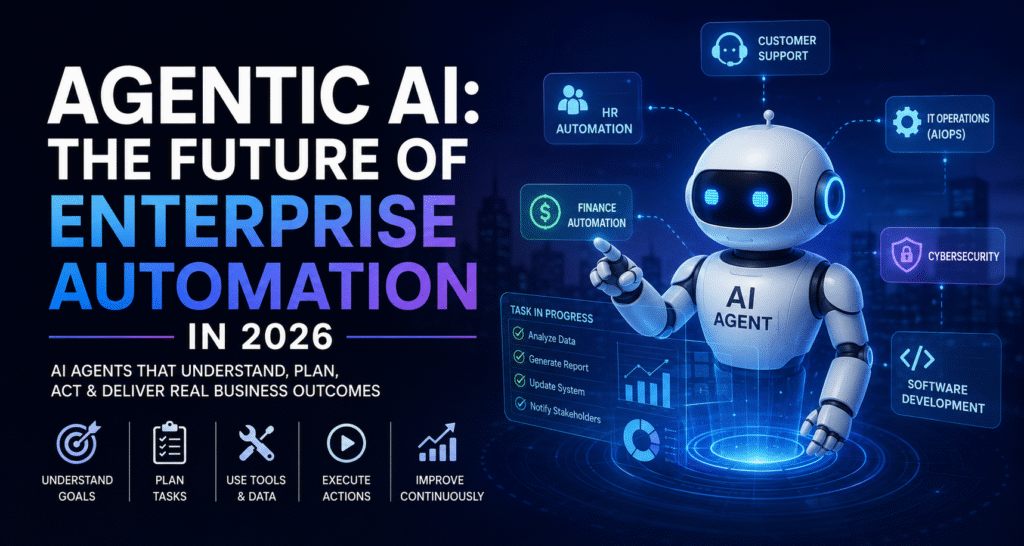
Agentic AI: The Future of Enterprise Automation in 2026 and Beyond
Artificial Intelligence is no longer limited to chatbots or content generation. In 2026, the next major shift in AI is Agentic AI, also known as AI Agents.
While Generative AI changed how we create content, Agentic AI is changing how work gets done. AI Agents can understand goals, plan tasks, use tools, analyze data, make recommendations, and execute workflows across business systems.
In simple words:
Generative AI answers questions. Agentic AI gets work done.
What is Agentic AI?
Agentic AI refers to AI systems that can autonomously pursue goals, make decisions within defined boundaries, access information, use tools, and execute actions to achieve a specific business objective.
Unlike traditional AI systems that only respond to prompts, Agentic AI can break complex tasks into smaller steps and complete them through a structured workflow.
Key Capabilities of Agentic AI
- Understands business goals
- Breaks complex tasks into smaller steps
- Accesses enterprise knowledge and documents
- Uses APIs, tools, and business applications
- Executes workflows
- Tracks outcomes
- Works with human approval where required
Agentic AI vs Generative AI
Many people think Agentic AI is the same as Generative AI, but both are different.
| Feature | Generative AI | Agentic AI |
|---|---|---|
| Main Purpose | Generates content | Completes tasks and workflows |
| Output | Text, image, code, or answer | Action, workflow, or business outcome |
| Example | Draft an email | Draft an email, update CRM, and schedule follow-up |
| Autonomy | Limited | Higher |
| Business Use | Content creation and Q&A | Automation, operations, and decision support |
How Do AI Agents Work?
A modern AI Agent usually works through multiple layers. These layers allow the agent to understand a goal, create a plan, access knowledge, use tools, and execute actions.
1. Goal Understanding
The agent first understands what the user wants to achieve. For example, a user may ask the agent to process invoices, analyze support tickets, or generate a financial report.
2. Planning
After understanding the goal, the agent breaks the task into smaller steps. This allows the agent to work in a structured and logical manner.
3. Knowledge Access
AI Agents can access internal documents, policies, databases, knowledge bases, SharePoint repositories, Confluence pages, and enterprise search systems.
4. Tool Usage
AI Agents can connect with tools and systems such as CRM, ERP, HRMS, ITSM, cloud platforms, email, calendar, ticketing systems, and databases.
5. Execution
Once the plan is ready, the agent can perform actions such as creating tickets, updating records, sending emails, generating reports, or triggering workflows.
6. Human Approval
For sensitive tasks, human approval should be added. This reduces business, compliance, and security risks.
Business Use Cases of Agentic AI
Agentic AI can be used across multiple business functions. Below are some of the most practical enterprise use cases.
1. HR Policy AI Agent
HR teams can use AI Agents to answer employee questions related to leave policy, payroll, onboarding, insurance, benefits, appraisal process, and internal guidelines.
Example:
An employee asks, “How many casual leaves do I have?”
The AI Agent checks HR policy, employee data, and leave balance, then provides an accurate answer.
2. Finance AI Agent
Finance teams can use AI Agents to validate invoices, detect expense anomalies, generate monthly reports, reconcile payments, and trigger approval workflows.
3. IT Operations AI Agent
IT teams can use AI Agents to monitor alerts, analyze logs, summarize incidents, identify root causes, create Jira or ServiceNow tickets, and suggest remediation steps.
4. Customer Support AI Agent
Customer support teams can use AI Agents to classify tickets, answer customer queries, retrieve customer history, generate responses, and escalate complex issues to human agents.
5. Software Development AI Agent
Development teams can use AI Agents for code review, bug analysis, test case generation, pull request summaries, documentation, and deployment readiness checks.
6. Cybersecurity AI Agent
Security teams can use AI Agents to analyze alerts, prioritize threats, correlate events, identify suspicious activity, and assist security analysts during investigations.
Enterprise Architecture for Agentic AI
A production-grade Agentic AI solution requires a secure, scalable, and governed architecture. Enterprises should not give unrestricted access to AI Agents.
1. User Experience Layer
- Web Portal
- Chatbot
- Microsoft Teams Bot
- Mobile App
- Enterprise Portal
2. Agent Orchestration Layer
- LangGraph
- CrewAI
- AutoGen
- Semantic Kernel
- Custom Agent Frameworks
3. AI Model Layer
- Azure OpenAI
- OpenAI GPT Models
- AWS Bedrock
- Google Vertex AI
- Anthropic Claude
- Open-source LLMs
4. Knowledge Layer
- Vector Database
- Azure AI Search
- Pinecone
- Weaviate
- Milvus
- FAISS
- Enterprise Document Repository
5. Integration Layer
- ERP Systems
- CRM Systems
- HRMS Platforms
- ITSM Tools
- Databases
- Cloud Services
- Email and Calendar Systems
6. Security and Governance Layer
- Role-Based Access Control
- Audit Logs
- Prompt Logging
- PII Masking
- Data Loss Prevention
- Human Approval Workflow
- Policy Guardrails
7. Monitoring Layer
- Cost Monitoring
- Latency Tracking
- Accuracy Monitoring
- Hallucination Detection
- User Feedback
- Task Success Rate
Popular Tools Used for Building AI Agents
Some popular technologies used to build Agentic AI solutions include:
- Azure OpenAI
- AWS Bedrock
- Google Vertex AI
- OpenAI APIs
- LangChain
- LlamaIndex
- Semantic Kernel
- CrewAI
- AutoGen
- LangGraph
- Azure AI Search
- Pinecone
- Weaviate
- Milvus
- FAISS
- Power Automate
- Azure Logic Apps
- n8n
- Zapier
- LangSmith
- OpenTelemetry
- Azure Monitor
- AWS CloudWatch
What are Multi-Agent Systems?
A Multi-Agent System is a setup where multiple specialized AI Agents work together to complete a business process.
Example: In a finance automation system:
- Data Agent: Fetches invoice data
- Validation Agent: Checks vendor, GST, PO, and payment details
- Risk Agent: Detects anomalies
- Approval Agent: Sends approval request to manager
- Reporting Agent: Generates monthly finance summary
Benefits of Agentic AI
- Improves employee productivity
- Reduces repetitive manual work
- Improves customer experience
- Speeds up decision-making
- Reduces operational cost
- Improves knowledge management
- Enables scalable enterprise automation
Risks and Challenges of Agentic AI
Agentic AI is powerful, but it also introduces serious risks. Enterprises must handle these risks carefully before moving AI Agents into production.
1. Hallucination
AI Agents may generate incorrect information if they do not have access to trusted data sources.
2. Data Privacy
Sensitive business or customer data may be exposed if proper security controls are missing.
3. Prompt Injection
A malicious user may try to manipulate the agent by providing harmful or misleading instructions.
4. Wrong Action Execution
Without proper guardrails, an AI Agent may send the wrong email, update the wrong record, or trigger an incorrect workflow.
5. Compliance Risk
Industries such as banking, insurance, healthcare, and finance require strong audit, approval, and compliance controls.
Best Practices for Implementing Agentic AI
- Start with a low-risk use case
- Use RAG with trusted enterprise data
- Add human approval for sensitive actions
- Enable audit logging
- Apply role-based access control
- Mask sensitive and personal data
- Monitor cost, latency, and accuracy
- Measure real business impact
Future of Agentic AI
The future enterprise will have both human employees and AI Agents working together. AI Agents will reduce repetitive work and help employees focus on decision-making, strategy, innovation, and customer relationships.
In the coming years, AI Agents will become part of almost every enterprise platform, including CRM, ERP, HRMS, ITSM, cybersecurity, cloud operations, data analytics, software development, and customer support.
Conclusion
Agentic AI is one of the most important technology shifts in 2026. It is not just another chatbot trend. It is the next stage of AI-driven enterprise automation.
While Generative AI creates content, Agentic AI understands goals, plans actions, uses tools, connects with business systems, and completes workflows.
The real value of Agentic AI will come from secure architecture, enterprise data integration, governance, observability, and measurable business outcomes.
Final thought:
Generative AI answers questions. Agentic AI gets work done.
Frequently Asked Questions
1. What is Agentic AI?
Agentic AI is an AI system that can understand a goal, plan multiple steps, use tools, and execute actions to complete a task.
2. What is the difference between an AI Agent and a chatbot?
A chatbot mainly responds to questions. An AI Agent can respond, use tools, analyze data, and trigger workflows.
3. How is Agentic AI useful for business?
Agentic AI helps businesses automate support, HR, finance, IT operations, sales, analytics, cybersecurity, and software development workflows.
4. Will Agentic AI replace jobs?
Agentic AI will automate repetitive tasks, but human roles in strategy, governance, decision-making, creativity, and innovation will remain important.
5. What skills are required to work with Agentic AI?
Important skills include cloud platforms, APIs, Python, LLMs, RAG, vector databases, workflow automation, cybersecurity, data governance, and enterprise architecture.
Suggested SEO Tags
Tags: Agentic AI, AI Agents, Enterprise AI, AI Automation, Generative AI, RAG, AI Agent Architecture, Multi-Agent Systems, Future of AI, AI in Business, Cloud AI, AI Governance, Enterprise Automation, AI Transformation, Solution Architecture